
DAFT vs Self-Employed Permit in the Netherlands

For foreign entrepreneurs considering business immigration to the Netherlands, one of the first questions is which residence permit provides the most appropriate legal pathway. Although the Dutch-American Friendship Treaty (DAFT) residence permit and the regular Dutch self-employed residence permit both allow entrepreneurs to establish and operate a business in the Netherlands, they are founded on different legal principles and are subject to significantly different eligibility requirements.
The distinction is particularly important for U.S. citizens. While most non-EU entrepreneurs must demonstrate that their proposed business serves an essential Dutch economic interest through a formal assessment conducted by the Netherlands Enterprise Agency (RVO), American entrepreneurs may benefit from a separate treaty-based framework established under the Dutch-American Friendship Treaty. As a result, the application process, documentary requirements, and overall legal threshold differ substantially.
Understanding these differences before selecting an immigration route can help entrepreneurs avoid unnecessary delays, prepare appropriate documentation, and choose the residence permit that best aligns with their business objectives.

The Main Difference
The Dutch-American Friendship Treaty (DAFT) establishes a dedicated residence permit for U.S. citizens who intend to operate an independent business in the Netherlands.
By contrast, the regular Dutch Self-Employed Permit applies to entrepreneurs from most countries outside the European Union and European Economic Area. Under this route, applicants must demonstrate that their business provides an essential economic benefit to the Netherlands through the statutory assessment process administered by the IND with advice from the Netherlands Enterprise Agency (RVO).
For most U.S. citizens, DAFT represents the more practical immigration pathway because applicants are generally exempt from the standard RVO points-based economic assessment. Instead, the IND evaluates compliance with the specific requirements established under the treaty.
1. Who Can Apply?
DAFT
DAFT is available primarily to citizens of the United States.
A comparable treaty-based regime also applies to Japanese nationals under the Dutch-Japanese Trade Treaty of 1912, which provides substantially similar benefits, including the same minimum capital requirement of €4,500.
Certain bilateral treaties with other countries contain comparable provisions, although their practical application differs.
To qualify under DAFT, the applicant must be a U.S. citizen and operate a genuine self-employed business in the Netherlands.
Regular Self-Employed Permit
The regular self-employed permit is available to entrepreneurs from countries outside the EU/EEA.
Unlike DAFT, applicants must demonstrate that their proposed business serves an essential Dutch economic interest. This assessment is usually carried out by the Netherlands Enterprise Agency (RVO) using the official points-based system.
2. Business Assessment
DAFT
This is the single greatest advantage of DAFT.
Applicants are generally exempt from the standard RVO points-based assessment.
As a result, U.S. entrepreneurs are normally not required to prove that their business is innovative, creates employment, or provides exceptional economic value to the Netherlands in the same manner required under the regular self-employed route.
Instead, the IND focuses primarily on:
U.S. citizenship;
registration of a Dutch business;
genuine entrepreneurial activity;
maintaining the required investment;
operating as a self-employed entrepreneur rather than as a salaried employee.
This exemption from the RVO assessment is what makes DAFT accessible to freelancers, consultants, online entrepreneurs, and many small business owners. By comparison, the regular self-employed permit has historically had a relatively low approval rate because applicants must satisfy a much stricter economic evaluation.
Regular Self-Employed Permit
The regular self-employed permit involves a far more demanding assessment.
Both the IND and the RVO evaluate whether the proposed business contributes sufficiently to the Dutch economy.
The RVO generally reviews:
the business plan;
the applicant's professional experience;
market analysis;
innovative aspects of the business;
financial forecasts;
economic value to the Netherlands.
3. Minimum Investment
DAFT
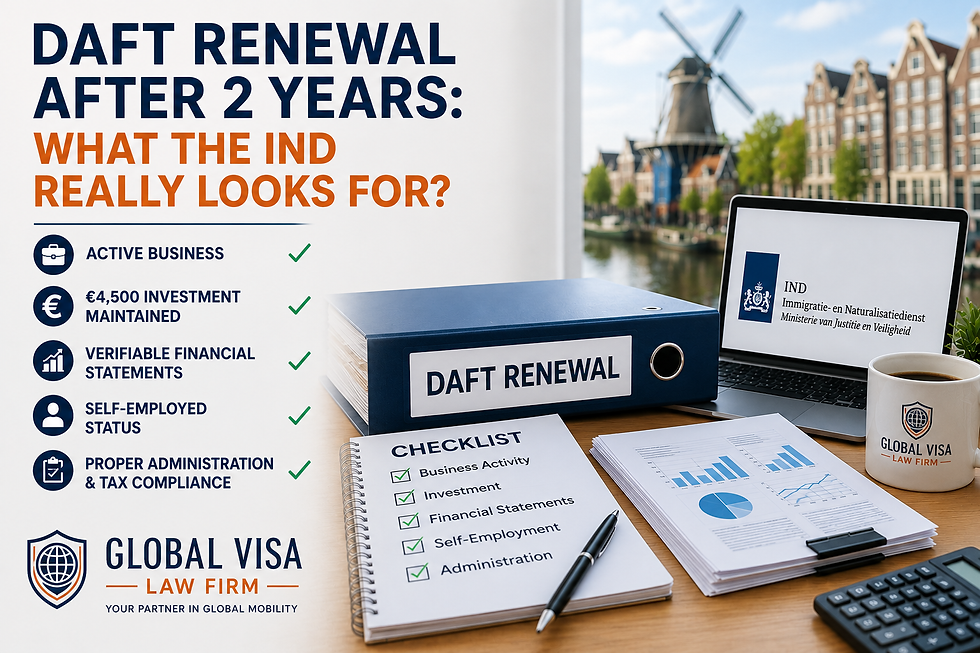
One of the key financial requirements under DAFT is maintaining a minimum investment of €4,500 in the Dutch business.
More importantly, applicants must maintain sufficient company equity rather than merely keeping €4,500 in the business bank account.
Ownership requirements also depend on the legal structure of the business.
For an eenmanszaak (sole proprietorship), the entrepreneur naturally owns 100% of the business.
However, where the business operates through a Dutch BV with multiple shareholders, the U.S. applicant must legally own at least 25% of the company. This is not simply common practice—it is an IND requirement intended to ensure that the applicant exercises meaningful control over the business. If ownership falls below this threshold, the IND may conclude that the applicant does not have sufficient control to qualify under DAFT.
Regular Self-Employed Permit
The regular self-employed permit does not have a simple fixed investment requirement comparable to DAFT.
Instead, financial viability forms part of the overall economic assessment carried out by the IND and the RVO, taking into account financing, projected income, market demand, and long-term sustainability.
4. Business Plan
DAFT
One of the most significant practical differences concerns the business plan.
For DAFT, the business plan is generally not subject to a formal evaluation by the RVO.
In practice, many immigration lawyers submit a concise description of the proposed business activities simply to explain the nature of the enterprise to the IND and the Dutch Chamber of Commerce (KvK).
In other words, under DAFT the business plan serves primarily an informational rather than an evaluative function.
Regular Self-Employed Permit
For the regular self-employed permit, the business plan is one of the most important documents in the entire application.
It often exceeds forty pages and must demonstrate, through detailed financial projections and market analysis, that the proposed business provides substantial economic value to the Netherlands.
Weak or poorly documented business plans are among the most common reasons for refusal.
5. Right to Work
DAFT
A DAFT residence permit authorizes the holder to work only within his or her own business.
It does not provide unrestricted access to salaried employment in the Netherlands.
In practice, the residence card states that self-employment is permitted, while employment as a salaried worker generally requires a separate work authorization (TWV) unless another immigration category applies.
Regular Self-Employed Permit
The same general principle applies.
The permit authorizes entrepreneurial activities within the applicant's own business.
Regular employment usually requires separate work authorization.
6. Spouse and Family Members
One of the greatest practical advantages of both DAFT and the regular self-employed permit concerns accompanying family members.
Spouses and registered partners may generally receive residence permits for the same duration as the principal applicant.
Even more importantly, dependent spouses usually receive unrestricted access to the Dutch labour market.
Their residence cards generally state:
"Arbeid vrij toegestaan. TWV niet vereist."
This means they may work for virtually any Dutch employer without requiring a separate work permit.
For many American families, this provides significant financial flexibility while the principal DAFT entrepreneur focuses on building the business.
7. Duration and Renewal
A DAFT residence permit is initially issued for two years.
If the entrepreneur continues operating an active business, maintains the required investment, and satisfies the DAFT conditions, the IND generally grants a renewed residence permit for five years.
By comparison, holders of the regular self-employed permit must also demonstrate that their business remains active and continues to satisfy the relevant immigration requirements.
During renewal, the IND may again review:
business activity;
financial documentation;
tax compliance;
administrative records;
continued compliance with the conditions of the residence permit.
Final Thoughts
For U.S. citizens, DAFT represents a unique and significantly more accessible immigration pathway than the standard Dutch self-employed permit.
Its principal advantage lies in the exemption from the standard RVO points-based assessment, allowing American entrepreneurs to establish genuine businesses in the Netherlands without having to prove that their enterprise serves an essential Dutch economic interest through the regular evaluation procedure.
By contrast, the regular self-employed permit remains a considerably more demanding immigration route for entrepreneurs from most other non-EU countries. Applicants must present a strong business case supported by a comprehensive business plan and convincing evidence that their activities provide measurable economic value to the Netherlands.
In short, for most U.S. entrepreneurs, DAFT is generally the preferred immigration route. For non-U.S. nationals, the regular Dutch self-employed permit may still be available, but obtaining approval typically requires a substantially stronger business case and a far more rigorous economic assessment.


Opmerkingen