
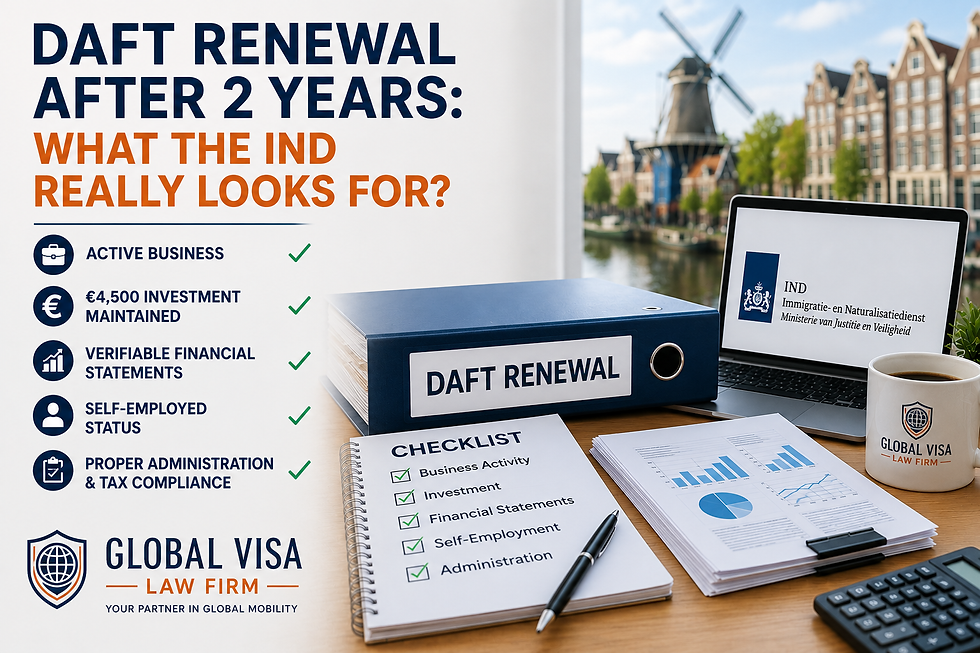
DAFT Renewal After 2 Years: What the IND Really Looks For?

Many entrepreneurs believe that the most difficult part of the Dutch-American Friendship Treaty (DAFT) process is obtaining the initial residence permit. In practice, this is not always the case.
The first DAFT application is largely based on the applicant’s intention to establish and operate a business in the Netherlands. At renewal, however, the Dutch Immigration and Naturalisation Service (IND) no longer evaluates only plans or expectations. After two years, the IND looks at what has actually happened.
The central question is simple:
Are you genuinely operating your own business in the Netherlands, or have you merely kept a company on paper in order to maintain your residence permit?
The renewal process is built around this question.
1. Is Your Business Actually Active?
This is probably the most important issue in a DAFT renewal.
The IND does not require the business to be large, highly profitable, or rapidly expanding. However, it must be clear that the business is real and active.
Typical evidence may include:
issued invoices;
client contracts;
payments received into the business account;
business expenses;
bookkeeping records;
tax filings;
regular commercial activity.
In other words, the IND looks for a clear “trail of enterprise” — a consistent documentary record showing that the company has genuinely been operating.
A particularly useful indicator is the timely filing of quarterly VAT returns, known in Dutch as BTW-aangifte. Even if a quarter shows little or no turnover, the fact that VAT returns are filed on time helps demonstrate that the business remains administratively active and compliant.
2. Has the €4,500 Investment Been Maintained?
This is one of the most common sources of problems in DAFT renewal cases.
Many applicants mistakenly believe that they only need to keep €4,500 in their business bank account. In reality, the requirement is more precise.
The IND looks not merely at the cash balance, but at the company’s equity — in Dutch, eigen vermogen.
For example:
business bank account balance: €5,000;
outstanding VAT liability: €1,500.
In this situation, the company’s equity may be only €3,500.
For DAFT purposes, that may mean that the required investment has not been maintained.
This distinction between cash and equity is critical. Outstanding debts, unpaid invoices, tax liabilities, VAT reserves, or other obligations may reduce the company’s net equity below the required threshold. If the equity falls below €4,500, the applicant may no longer satisfy the DAFT conditions.
For that reason, many Dutch accountants recommend keeping a buffer above the minimum amount, often around €6,000 to €7,000, so that ordinary expenses or tax obligations do not accidentally bring the company below the required level.
3. Can Your Financial Statements Be Verified?
At renewal, a bank statement alone is usually not enough.
The IND generally expects financial documentation that allows the company’s financial position to be assessed objectively.
This may include:
a balance sheet;
a profit and loss statement;
bookkeeping records;
business bank statements;
tax returns;
VAT filings, where applicable.
In practice, these documents are usually prepared or confirmed by a Dutch accountant or tax adviser.
This is especially important under the IND pilot procedure. Under that procedure, some DAFT applicants may receive approval more quickly without immediately submitting all final business registration and banking documents. However, they must later provide proper financial documentation, including an opening balance prepared by a qualified accountant or tax adviser with a BECON number. Similar documentation is also relevant at the two-year renewal stage.
The practical point is clear: the IND wants verifiable financial records, not only screenshots or informal bank summaries.
4. Are You Really Self-Employed?
This issue has become increasingly important.
The Netherlands has intensified its focus on schijnzelfstandigheid, meaning false self-employment.
This occurs when someone is formally presented as a freelancer or business owner, but in practice works like an employee. If the Dutch Tax Administration, the Belastingdienst, concludes that the relationship is actually employment, this can create serious tax and immigration risks.
Particular attention may be drawn to situations where:
the entrepreneur has only one client;
that client is a former employer;
the client determines the working schedule;
the entrepreneur uses the client’s equipment;
there is little or no entrepreneurial risk;
the entrepreneur is subject to the client’s management or supervision;
the work relationship looks almost identical to the former employment relationship.
Although the IND makes its own immigration assessment, the practical substance of the business relationship is highly relevant. If the evidence suggests that the applicant is effectively working as an employee rather than operating an independent business, this may affect the renewal.
This point is now even more important because the Netherlands has resumed stricter enforcement of the Wet DBA, the law aimed at combating false self-employment. The Belastingdienst has become more active in reviewing freelancer arrangements and may scrutinize one-client structures more closely than before.
For DAFT entrepreneurs, especially those serving a former U.S. employer, it is therefore important to reduce risk by:
using a genuine business-to-business service agreement;
working with your own equipment where possible;
maintaining control over how the work is performed;
bearing normal entrepreneurial risk;
building a broader client base, ideally with at least several clients;
documenting business development efforts.
A B2B contract alone is not enough if the actual working relationship still looks like employment.
5. Revenue Matters Less Than Business Activity
Another common misconception concerns income.
Unlike some other Dutch immigration routes, DAFT does not impose a fixed minimum profit or turnover requirement. This means that a business may be small, may still be developing, or may have modest profits during the first two years.
However, this does not mean that income is irrelevant.
The general immigration principle remains that the applicant should not become dependent on Dutch public assistance, such as bijstand. The business should generate enough income to support the applicant’s basic living costs, or the applicant should have sufficient personal savings to show that they will not become a burden on the Dutch social welfare system.
Therefore, the IND is usually less concerned with whether the company is highly profitable, and more concerned with whether:
the business is real;
the business is active;
the entrepreneur can support themselves;
the DAFT conditions continue to be met.
6. Has Your Administration Been Properly Maintained?
The IND expects a DAFT entrepreneur to operate like any other Dutch business owner.
This includes:
filing tax returns on time;
maintaining proper bookkeeping;
keeping invoices and contracts;
preserving business records;
complying with Dutch tax obligations;
filing VAT returns where required.
Poor administration can create problems even if the business itself is genuine. If records are incomplete, inconsistent, or prepared only shortly before renewal, the application may attract additional questions.
Good administration from the beginning of the residence period is one of the strongest ways to support a DAFT renewal.
7. Is the Business Consistent With the Original Application?
At renewal, the IND may also consider whether the applicant is still carrying out the type of entrepreneurial activity for which the residence permit was originally granted.
A business is allowed to develop, adapt, or even change direction. A complete change of business activity is not automatically prohibited. However, the applicant must still be able to show that they are conducting real independent business activity and continue to meet the DAFT requirements.
The key issue is not whether the business is identical to the original plan, but whether it remains genuine, active, and compliant.
Common Reasons Why DAFT Renewals Become Difficult
In practice, DAFT renewal problems usually arise not because the business is too small, but because the applicant cannot properly document that the business is real and compliant.
Common problems include:
company equity falling below €4,500;
lack of evidence of genuine business activity;
signs of false self-employment;
only one client, especially a former employer;
poor bookkeeping;
missing financial statements;
late or missing tax filings;
failure to file VAT returns;
lack of contracts or invoices;
long periods with no commercial activity.
Final Thoughts
A DAFT renewal after two years is not simply a repeat of the initial application. It is a review of whether the entrepreneur has actually fulfilled the conditions of the residence permit.
From the IND’s perspective, the size of the business and the level of profit are not the only decisive factors. What matters more is whether the applicant can document three core points:
the business is genuinely active;
the entrepreneur remains an independent business owner;
the financial and administrative conditions of DAFT continue to be satisfied.
Entrepreneurs who maintain proper bookkeeping from the start, keep the required equity safely above €4,500, file tax and VAT returns on time, use genuine B2B contracts, avoid false self-employment risks, and document their business activity throughout the two-year period are usually in a much stronger position at renewal than those who begin collecting evidence only shortly before filing.
For DAFT holders, the safest approach is to treat renewal preparation not as a last-minute administrative task, but as an ongoing compliance process from the first month of residence in the Netherlands.


Opmerkingen