
Information about DAFT - The Dutch American Friendship Treaty
The Dutch American Friendship Treaty
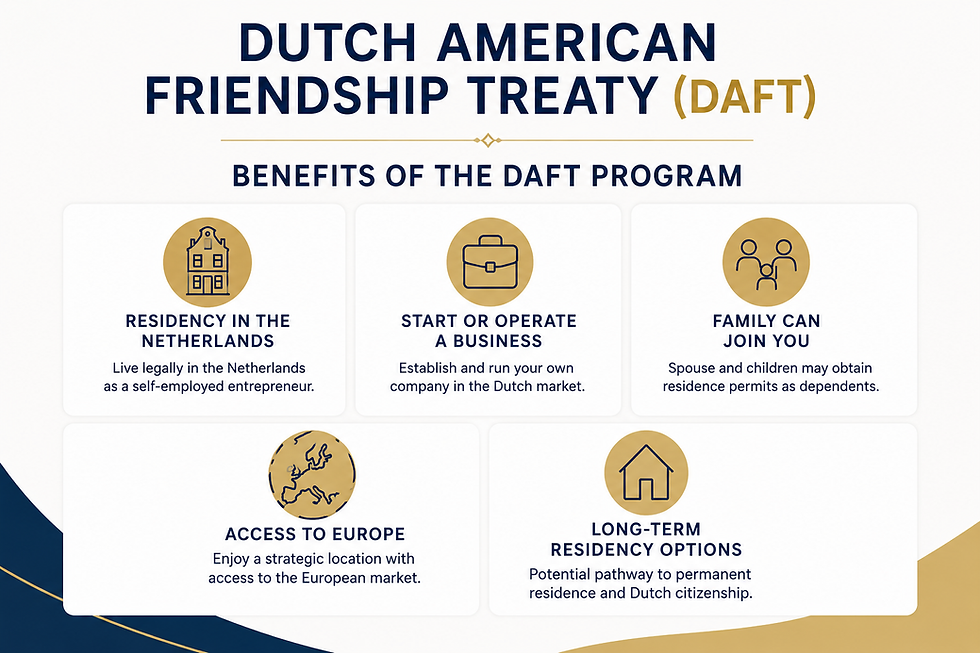
The Dutch American Friendship Treaty (DAFT), signed in 1956 between the United States and the Netherlands, was originally intended to encourage trade and economic development under the Marshall Plan. Today, it offers American entrepreneurs a unique and simplified opportunity to obtain residence in the Netherlands while operating their own business.
Through the Dutch American Friendship Treaty, U.S. citizens can establish a business and obtain residence in the Netherlands with a relatively modest investment. The required investment amount has remained unchanged since the 1950s and is currently set at €4,500 (US $ 5,280).This requirement can only be met once the business is actually registered and there is a business bank account in the name of the business.
The DAFT visa does not require applicants to satisfy a complex points-based assessment designed to determine whether an entrepreneur and their new business provide sufficient “added value” to the Dutch economy, due to the special friendship relationship between the United States and the Netherlands.
The DAFT visa is available to entrepreneurs of all typies — from self-employed professionals and freelancers to owners of large companies seeking to establish a representative office or branch of their successful business in the Netherlands.
The program does not impose restrictions regarding:
-
the type of business activity;
-
the category of the company’s clients;
-
the country of residence or origin of the clients.
Who Can Use the DAFT Program?
The Dutch American Friendship Treaty (DAFT) program is available exclusively to U.S. passport holders who intend to establish and personally operate a business in the Netherlands.
The business must be active and generate income within the Netherlands.
At the same time, DAFT status is intended solely for entrepreneurs and cannot be used concurrently with traditional employment for an employer.
Basic Requirements for Participation in the DAFT Program
• U.S. citizenship.
• Registration and operation of a business in the Netherlands.
• No regular employment; the applicant must own at least 25% of a Dutch company.
• Conducting genuine income-generating business activities.
Who Is This Program Not Suitable For?
• Individuals who rely exclusively on passive income or pension payments.
• Companies that do not actually conduct business activities.
• Individuals intending to work under an employment contract as employees.
• Individuals intending to use inactive or formally existing (“shell” or “dormant”) companies without conducting business activities.
Position of family members
A US entrepreneur can bring their partner and minor-aged children to the Netherlands. Both the partner and the minor-aged children can acquire a family member permit. Partners can be either married or unmarried, and they can be of different or the same gender.
The immigration rules do vary depending on whether you are married or not. For example, unmarried couples need to show that they have a genuine and lasting relationship with one another, while married couples need to have their marriage certificate legalized. As from 1 January 2021, a US entrepreneur's partner and children are allowed to work in the Netherlands without a work permit.
In fact, family members work authorization is even broader than that of the principal DAFT holder, as they may:
• work as employees;
• start and operate their own business.
The DAFT holder, however, must remain self-employed in the business on the basis of which the application was submitted.
Adult children or (grand)parents can only join under exceptional circumstances, under a so-called Article 8 procedure.
DAFT Program Requirements: Business Structure, Investment, and Required Documents
To obtain a residence permit under the Dutch American Friendship Treaty (DAFT) program, the applicant must conduct business activities through a company or sole proprietorship registered in the Netherlands.
The application process requires compliance with several requirements related to business registration, maintaining the mandatory €4,500 investment deposit, and providing the necessary supporting documentation.
Establishing a small business also meets the requirements.
This includes:
-
working as a freelancer;
-
engaging in cross-border activities as an independent contractor ( Form - 1099 ) from the Netherlands.
You may conduct business with anyone you choose, as long as your business generates income.
Business Structure
The applicant must register their own business in the Netherlands. Under the DAFT program, various forms of entrepreneurship are permitted, including:
-
a sole proprietorship (ZZP / Eenmanszaak);
-
a private limited liability company (BV – Besloten Vennootschap).
For information about the differences between the legal forms of business entities and how to make the right choice, please follow the link and read more here.
The business must be operational and engaged in genuine commercial activities that generate income.
What do you need for a DAFT application?
The DAFT visa has a number of document requirements:
-
Passport copies for everyone, including children.
-
Birth certificates for everyone, including children. These documents need to be apostilled (see link here).
-
Marriage / non-marriage certificate (if applicable). These documents need to be apostilled
A further note on certificates and apostilles:
-
An apostille is an extra piece of paper attached to a certificate, that says something like "Convention de La Haye du 5 octobre 1961" or similar wording. If you have original documents that only need to be (re-)apostilled, you can quite easily do this at an online notary service provider via google.
-
Apostilles on birth certificates are valid indefinitely. Apostilles on all other documents are valid for 6 months.
-
Many US passport holders are not actually born in the United States. But naturalization certificates (or similar documents) are no replacement for birth certificates. You need the actual birth certificate from the country of birth.
Biometrics
As part of the residence permit application process, applicants are required to provide their biometric information to the Dutch Immigration and Naturalisation Service (IND). This includes:
-
fingerprints;
-
a facial photograph;
-
a signature sample.
The residence permit card cannot be issued until the applicant's biometric data has been collected and registered by the IND.
Municipal Registration (City Hall Registration)
Unlike the United States, anyone intending to reside in the Netherlands must register with the Dutch Personal Records Database (BRP – Basisregistratie Personen) through their local municipality.
To complete the registration process, applicants must demonstrate that they are legally permitted to reside in the Netherlands.
In addition, municipal authorities will typically request supporting documentation such as:
-
written consent from the landlord;
-
a residential lease agreement;
-
or a property purchase agreement.
Is a Business Plan Required for a DAFT Application with the IND?
In most cases, a business plan is not required for a DAFT application submitted to the IND.
This is one of the main advantages of the Dutch American Friendship Treaty (DAFT) program compared to the standard Dutch residence permit for self-employed entrepreneurs.
In other words:
-A business plan is generally not required.
- There is no points-based assessment.
-Applicants are not required to demonstrate “added value” to the Dutch economy.
-The primary focus is on business registration and compliance with the DAFT requirements.
However, in practice, the IND may still verify that:
-
the business genuinely exists;
-
the business activities are not fictitious;
-
the applicant is genuinely operating as an entrepreneur;
-
the conditions of the DAFT program are being met.
As a result, applicants will commonly provide documents such as:
-
Chamber of Commerce (KvK) registration;
-
a business bank account;
-
proof of the €4,500 deposit;
-
client contracts (if available);
-
invoices (if available);
-
a description of the company’s business activities.
These documents do not constitute a business plan in the traditional sense, but rather serve as evidence of genuine entrepreneurial activity.
It is also important to note that, since 2026, the IND has begun conducting more active compliance reviews of DAFT visa holders and may request additional documentation to verify that the business is actively operating and remains compliant with the conditions of the program. Therefore, the absence of a business plan requirement does not mean the absence of oversight of the business.
Permanent residence and naturalization
After holding a DAFT visa for five consecutive years or longer in the Netherlands, a US entrepreneur can ask for permanent residence and/or naturalization.

Contact Us
Make your DAFT visa consultation
Inter your information to make an appointment
