

Sole proprietorship or private limited company?
American entrepreneurs applying for a DAFT visa typically choose between two business structures: an Eenmanszaak (sole proprietorship) or a BV (private limited company). Your choice will influence taxation, liability, compliance requirements, and access to certain tax advantages. Understanding the differences between these two structures is an important step in building a successful business in the Netherlands under the DAFT program.
Differences between an eenmanszaak and a BV
If you opt for an eenmanszaak, you can quickly get started with your business. You register at The Netherlands Chamber of Commerce and you can get started. For a BV, you need an official document (deed) from the notary. You can start a BV with several people, whereas an eenmanszaak can only have one owner.
There are other differences between an eenmanszaak and a BV. For example, which taxes you pay and how liability is regulated. If you have an eenmanszaak, you are also liable privately. You are then responsible for your company's debts with your private money. Or for damage someone suffers as a result of a product or service you sell.
Overview of differences
We have listed some of the most important differences between an eenmanszaak and a BV.
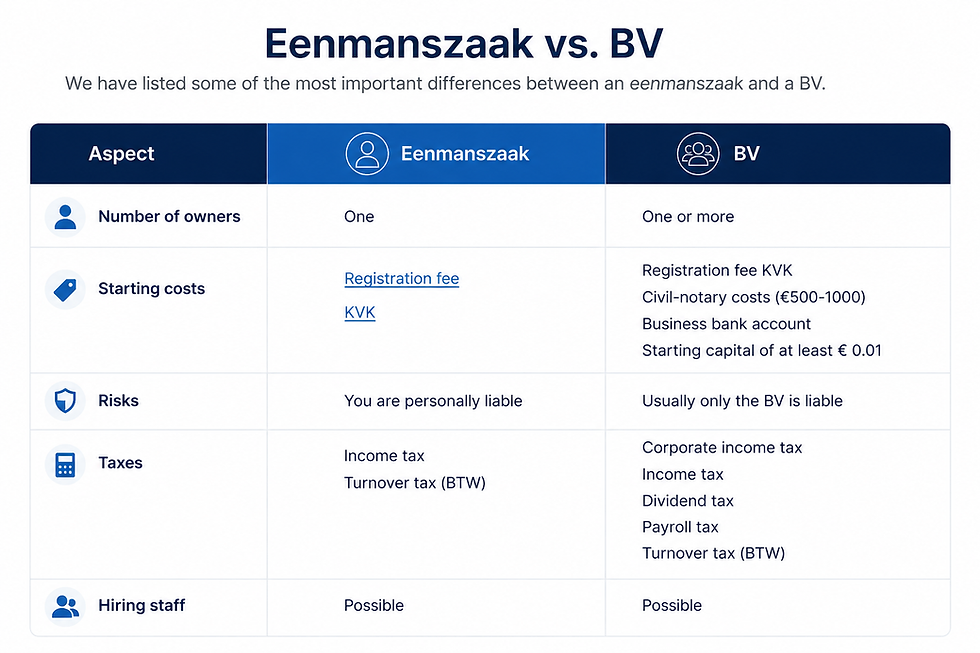.png)
What is dividend?
You can share your BV's profits with your shareholders. This payment is called a dividend.
Organisation of a BV
The organisation of a BV is more complex than an eenmanszaak. The BV is a legal entity, that is to say, it has legal personality. This means that a BV has rights and obligations under the law, just like people do. For example, a BV may enter into contracts and must abide by them.
A BV has a board that runs the company. You can decide how many people your board consists of. If you start a BV on your own, you are the only director. The person who runs a BV and has more than 5% of the shares is the director-major shareholder (DGA).
Shares and shareholders
A BV's money is divided into shares. If someone buys shares, they become a shareholder. Selling shares is a way to raise funds, but shareholders also have a say in how your company is run. For example, they are entitled to a share of the profit (dividend) and they have voting rights. If you do not want this, the eenmanszaak may be a better choice for you.
Profit and taxes
The money you earn by selling products or services is your turnover. If you subtract costs from that, you are left with your profit. If you make a lot of profit (in Dutch), a BV can have advantages. A BV pays less tax from a certain amount of profit than an eenmanszaak. Because you usually do not make much profit in the beginning, entrepreneurs often choose an eenmanszaak when starting their business.
Taxes for an eenmanszaak
With an eenmanszaak, you pay income tax on your profits every year. And you may be entitled to tax benefits for entrepreneurs, such as entrepreneurs' allowance and tax relief for new companies.
BV taxes
With a BV, you pay income tax and corporate income tax. If you share your profits with your shareholders, you also pay dividend tax.
As the owner of a BV, you are director-major shareholder (DGA). You are employed by the BV and the BV must pay you a minimum salary. In 2026, this is €58,000. This is called the gebruikelijkloonregeling (customary salary scheme). Does the BV not yet earn enough money to pay this minimum wage? Then you can apply to the Tax Administration for a lower salary.
You pay income tax on your own salary and dividend. The BV pays payroll taxes on your salary.
How do you choose?
You now know the main differences between an eenmanszaak and a BV. But how do you decide which legal form best suits your situation?
These questions can help you decide:
-
How much risk do you run with the products or services you sell?
If the risk is high, a BV may be wiser than an eenmanszaak. For example, if you collaborate on large projects where a lot of money is at stake. Moreover, you can set up several BVs (holding companies). This allows you to spread risks. -
Do you need investors?
If you need money from investors, a BV can be useful. You can then offer investors shares in your company. -
How much profit do you expect?
With a BV, you have to pay yourself a minimum of 56,000 euros a year in salary. If you do not make that much profit, there will be little money left over in the BV and you will have little tax advantage. With this calculation tool, you can work out what is cheapest in your situation. -
Would you like to be able to save money within the BV?
You can save profits within a BV. You can also save for your pension within the company. You do not (yet) pay income tax on the money you put aside for this. -
How complicated do you want to make it?
A BV is more complicated than an eenmanszaak. There are also more requirements for your administration, for example. You have to draw up annual accounts every year and file them with the Netherlands Chamber of Commerce.
Contact Us for more information
